
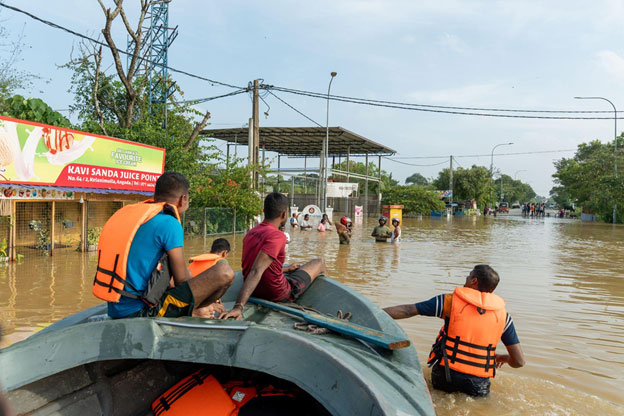


UNITED NATIONS, December 9 (IPS) – In late November, Cyclone Ditwah made landfall in Sri Lanka and southern India, bringing heavy rainfall that triggered widespread flooding and devastating landslides. The storm caused extensive damage to civilian infrastructure and resulted in a significant loss of life. Communities have been severely impacted, with limited access to essential services, while humanitarian agencies face challenges in reaching the most vulnerable populations.
According to figures from the United Nations Children’s Fund (UNICEF), approximately 1.5 million Sri Lankans are estimated to have been impacted by the cyclone, including over 275,000 children. Additionally, updated reports from the office of the United Nations Resident Coordinator (UN RC) in Sri Lanka indicate that 474 people have been killed, 356 are still missing, and around 201,875 individuals from 53,758 families are taking shelter in 1,564 government-supported shelters.
“UNICEF remains deeply concerned about the destruction the cyclone has caused to children and the vital services they depend on for their safety and well-being,” said Emma Brigham, UNICEF Representative in Sri Lanka. “Children urgently need help. It is a race against time to reach the most vulnerable families who (urgently) require lifesaving services. And while the cyclone may have passed, the consequences have not.”
The actual figures are projected to be even higher as communication disruptions and blocked entry points for humanitarian aid hinder accurate reporting and assistance efforts. Initial assessments from the UN RC in Sri Lanka show that more than 41,329 homes have been partially or fully destroyed, alongside the damaging of at least 10 bridges, the disruption of 206 roads rendered impassable, and sections of the rail network and power grid affected, and an inundated substation.
The Gampaha, Colombo, Puttalam districts are among the hardest-hit, with each district reporting north of 170,000 affected civilians. The Mannar, Trincomalee, Batticaloa, Badulla, and Matale districts have also reported considerable damage to civilian infrastructure and livelihoods as a result of flooding. The UN RC in Sri Lanka also notes that water levels in Colombo and the Kelani River region are beginning to slowly recede. However, northeast monsoon conditions are projected to gradually increase over the coming days, with heavy rains expected across several areas.
Furthermore, over 200 deadly landslides have been reported across several areas, with most occurring in the central highlands of the nation. The Kandy, Nuwara Eliya and Badulla districts recorded a significant loss of life, structural damage, and high volumes of civilian displacement, with landslide alerts extended until December 3.
“The people of Sri Lanka have not seen such widespread destruction in years,” said Kristin Parco, the International Organization for Migration (IOM) Chief of Mission in Sri Lanka. “Communities have been uprooted and many families are now sheltering in overcrowded, temporary spaces while facing immense uncertainty. We are entering a critical phase of this emergency, and mobilizing humanitarian assistance is essential to reduce the suffering of those displaced by Cyclone Ditwah and to ensure their safety, dignity, and access to basic services during this difficult time.”
Figures from IOM show that more than 209,000 Sri Lankans have been displaced in the days following the cyclone’s landfall. Additionally, IOM describes the ensuing floods as some of the most severe the country has experienced in almost two decades, noting that all 25 districts of Sri Lanka have been inundated, with 150-500 mm of continuous heavy rainfall and winds reaching 70–90 km/h over three days.
These challenges have significantly hampered both relief efforts and the ability to assess the full scope of the damage. IOM reports widespread power outages, blockages of critical access points, and severe disruptions to communication networks across the country. Additionally, several high-risk areas, such as Polonnaruwa, Kegalle, Kurunegala, and Colombo, to name a few, have been placed on red alert, with additional emergency evacuation orders being issued for communities along landslide-vulnerable slopes and low-lying river basin areas.
The UN RC for Sri Lanka reports that the country’s electricity and water infrastructure have sustained significant damage, which has had severe implications for public health and further strained the already collapsing national healthcare system. Numerous areas have already reported a near-total lack of clean drinking water, while health facilities continue to operate under severe shortages of essential supplies.
The World Health Organization (WHO) has expressed deep concern over the severe flood conditions, underscoring the heightened risks of vector-borne, food-borne, and water-borne diseases. The agency has called for increased public awareness around mosquito-bite prevention, safe food handling, and the importance of drinking safe, clean water.
Additionally, WHO has been in the process of delivering urgent support to Sri Lanka’s overwhelmed healthcare system, which has been severely strained by the influx of new patients following the cyclone. The agency, in partnership with WHO Southeast Asia Regional Health Emergency Fund (SEARHEF), is supporting mobilization and deployment of emergency public health teams who are positioned to deliver urgent care for trauma, as well as referrals for hospital care for pregnant women, children, elderly, and others.
Furthermore, WHO has pledged USD $175,000 to support emergency health services and continues to collaborate with national authorities and humanitarian partners to reach the most vulnerable populations with lifesaving care. “The funds will be used for rapid response teams to support essential health services for the affected communities, and for strengthening health information management and surveillance, key for timely detection of disease outbreaks to facilitate appropriate response,” said Dr Rajesh Pandav, WHO Representative designate to Sri Lanka.
IPS UN Bureau
© Inter Press Service (20251209080725) — All Rights Reserved. Original source: Inter Press Service