
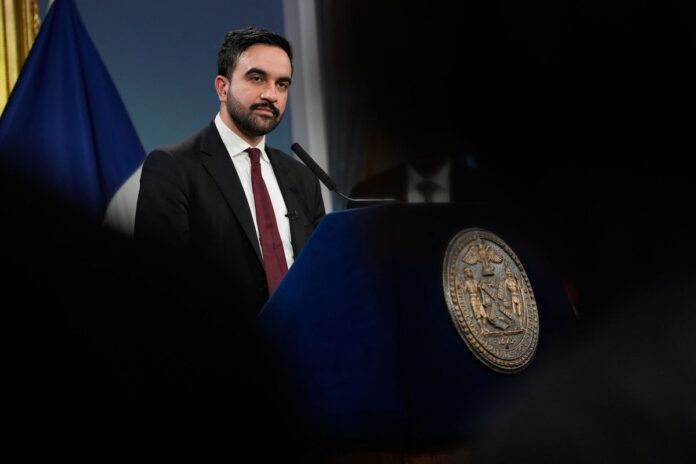


NEW YORK – Ever since Zohran Mamdani took office as New York City’s mayor in January, efforts to close the long-troubled Rikers Island jail complex have received renewed attention. The facilities — plagued for years by violence, overcrowding, neglect and poor medical care — are required by law to be closed by 2027, but are way behind schedule.
Mamdani — who had long wanted to shutter the facilities but opposed creating more jails to replace them — shifted his position during the mayoral campaign, saying he would follow the City Council plan to close Rikers, one of the world’s largest jail complexes, and move its occupants to four smaller jails to be built across the city.
Now in office, Mamdani faces the challenge of delivering on the plan: balancing public safety, working with a federal court-appointed overseer charged with improving conditions at Rikers, and navigating the expectations of activists upset over what they saw as stalling and obstruction by Mamdani’s predecessor, Mayor Eric Adams.
“I think they can be a historic administration in New York City and be the administration that oversees the closure of Rikers and the transformation of our jail system,” said Mary Lynne Werlwas, the director of The Legal Aid Society’s Prisoners’ Rights Project, which has been fighting to reform the city’s jails since the 1970s.
Since taking the helm, Mamdani has issued an executive order to develop a plan to stop using solitary confinement in jails, announced a housing project on a hospital campus for people returning from incarceration with chronic physical and mental health issues, and appointed a new jails commissioner, who was once formerly incarcerated at Rikers.
As construction continues on the replacement jails, the city is now contending with the possibility that the legally mandated 2027 closure will need to be pushed back again — potentially until 2032.
Here’s a look at where the effort to close Rikers stands:
What’s the latest at Rikers?
The jail complex, which sits on an island in the East River between the boroughs of Queens and the Bronx, has eight facilities in use. As of mid-February, the population of New York City jails stands at nearly 7,000, a return to levels seen before the pandemic. Many experts agree that this influx of people supercharges all the other issues plaguing the jail, resulting in tragic outcomes — such as in-custody deaths.
More than 30 people have died at Rikers since 2022, when the population first started to ratchet up after the end of the pandemic. At least 14 people died there last year, a decade since Rikers has been under federal oversight.
More significant oversight
In January, the judge overseeing the facilities, dismayed by the lack of progress in improving conditions, appointed an independent “remediation manager” named Nicholas Deml to take control of the jails to implement reforms. Deml has served as a CIA officer and as Vermont’s Department of Corrections commissioner.
Deml will have more power than the mayor when it comes to implementing changes to the city’s jails. Although former Mayor Adams did not want to lose control of lockups to the federal government, Mamdani has signaled that he is looking forward to collaborating with Deml.
City Council member Sandy Nurse, who organized protests against mass incarceration before she came to electoral politics, has faith in the new remediation manager. “You need an outside force with powers of the federal government that can do things a mayor cannot do,” including giving Mamdani cover to overcome political obstacles from potential budget constraints and opponents of Rikers’ closure, Nurse said.
Under construction
Although the city has closed some old facilities, it has failed to make the progress needed to shut down and replace Rikers by the 2027 deadline.
Nurse attributed some of the building delays to the COVID-19 pandemic. But she and the other criminal justice reform advocates whom The Marshall Project spoke with put most of the blame on Adams.
Although he initially backed the plan to close Rikers, Adams called to keep it open in 2025. Nurse said this flip was a failed bid to shore up his support during his reelection campaign with some Trump-supporting Republicans. She believes their objection to borough-based jails “comes from a place of anti-Blackness, racism and just wanting to throw people away and never see them again.”
Right now, estimates for the plan to close Rikers and replace it with new borough-based jails put its completion at 2032 — several years after the 2027 deadline.
“It seems far away, but it’s very close,” Nurse said, noting that “there will be some kind of renegotiation to amend the legislation so that the city stays in compliance [with the law] and is forced to achieve benchmarks along the way.”
Are there people against this plan?
Some New Yorkers have objected to the replacement locations. One of the most outspoken groups is Neighborhoods United Below Canal (NUBC), a non-profit that represents business owners and residents in Manhattan’s Chinatown.
That densely populated neighborhood is slated to house the world’s tallest jail. At around 300 feet, the new facility will tower over the area’s historic low-rise and tenement buildings. Although construction of the new jail will be underway soon, the NUBC is hopeful that there is still time to repurpose the site for housing.
The site of this new megajail is where the notorious “Tombs” jail used to be. That jail was shut down for many years in the 1970s due to the same kinds of concerns that now plague Rikers.
“We do want to close Rikers,” one of NUBC’s leaders, Vic Lee, recently told TMP, “but it should not come at the harm of the Chinatown community.” NUBC is calling for the city to build its new jail at a defunct federal corrections facility in a nearby neighborhood.
Instead of a megajail, the NUBC wants Mamdani to build homes where the Tombs once stood. “This is a mayor that campaigned on housing, specifically affordable housing,” said Jan Lee, another NUBC leader, “There is no other site in Chinatown where we could build the amount of housing that we have the opportunity to do now.”
Does anyone want to keep Rikers open?
Although the closure of Rikers is broadly popular, Benny Boscio, the leader of the Correction Officers’ Benevolent Association, a union that represents 15,000 active and retired NYC corrections officers, has called out the plan to shut down Rikers as inherently “flawed,” because the new borough-based jails will have a much lower capacity than the number of people currently incarcerated on the Island.
The Marshall Project reached out to Boscio multiple times via email for an interview, but he has yet to respond.
Meanwhile, advocates who applaud the lower capacity of the plan as a step towards decarceration wonder if COBA just wants more beds to justify more corrections jobs.
Can the city afford to close Rikers?
The cost of the plan to replace Rikers has ballooned from the initial estimate of $8 billion to at least $15 billion. Nurse attributes the increase to the rising costs of construction and the demand for the limited number of contractors who specialize in building large jails.
At the same time, the Mamdani administration is facing a $7 billion gap in the city’s $116 billion budget.
Werlwas believes the wealthiest city in the world has a long history of dealing with these gaps and still finding ways to pay for the things it deems important. In that sense, it’s less about the budget shortfall, and more about the priorities of the new mayor.
Despite the increasing costs and potential budget gaps, the urgency to shutter Rikers remains. “The facilities on Rikers are falling apart, and the cost to fix them is more expensive than building the new jails,” she said.
Was Mamdani always in support of the closure of Rikers?
In 2019, Mamdani was actually against the city council’s plan for Rikers. It wasn’t that he wanted to see the jail complex stay open, it’s that he didn’t want to see the city replace it with new jails. But in last year’s mayoral election, his position shifted. He was the only candidate who vowed to follow through on closing Rikers, explaining it as a commitment to simply follow the law.
Although executing the Rikers plan isn’t as radical as abolishing jails, Werlwas of Legal Aid Society said Mamdani still has a historic opportunity with Rikers — if he can couple its closure with more investment in the people who used to be incarcerated there.
“It’s not enough to say don’t invest in jail,” she said. “We need an affirmative investment in things that keep our communities safe, like supportive housing and mental health services. And it’s absolutely essential that we find ways to take care of people, because incarceration is an expensive and dangerous way to do so.”
What has Mamdani done so far?
In addition to issuing the solitary confinement executive order, Mamdani appointed Stanley Richards, a man who was once incarcerated at Rikers, to lead the Department of Corrections. And now, Richards has the task of working with Deml, the federal remediation manager.
“Stanley is someone who has dedicated his life to reentry programs, programs inside the jails, healing practices, mentoring, and really focused on reducing recidivism,” Nurse said. “So that to me is a tone that was set that everything else will flow from.”
Mamdani has also introduced new initiatives focused on mental health and housing that the mayor and advocates hope could decrease the number of people the city incarcerates.
On Martin Luther King Day, he announced that he would support Just Home, a supportive housing project in the Bronx that creates 83 rent-controlled apartments with onsite services for formerly incarcerated people with medical needs.
Although the plan had been approved by the city council in 2024, Adams advocated against it during his mayoral campaign. After Mamdani’s election, he said: “My sincere belief is that soon Just Home will be seen as clear evidence of New York’s commitment to a new era where every one of our neighbors — even those who’ve made mistakes in their past — is entitled to dignity, safety, and a home they can call their own.”
What do people who were formerly incarcerated at Rikers think?
Darren Mack, a survivor of Rikers who witnessed brutality during his time there in the 1990s and who currently leads the decarceration advocacy group Freedom Agenda, said he’s pleased with what he’s seen of Mamdani so far, but he is not satisfied.
“We applaud it, but there is much more that needs to be done,” he said. “Rikers can’t be fixed or reformed, and the only solution is closure.”